Photo Essay: Wild Atlantic Coasts
A month of coastal camping along the Irish, Scottish and Cornish Atlantic, and what an ocean edge looks like when you sleep on it.
Published
A month of camping along the North Atlantic coasts of Ireland, western Scotland and Cornwall, mostly under seven pounds of pack and always within earshot of the ocean. The essay collects the images and the small logistical notes that made them possible.
The Beara Peninsula, Ireland
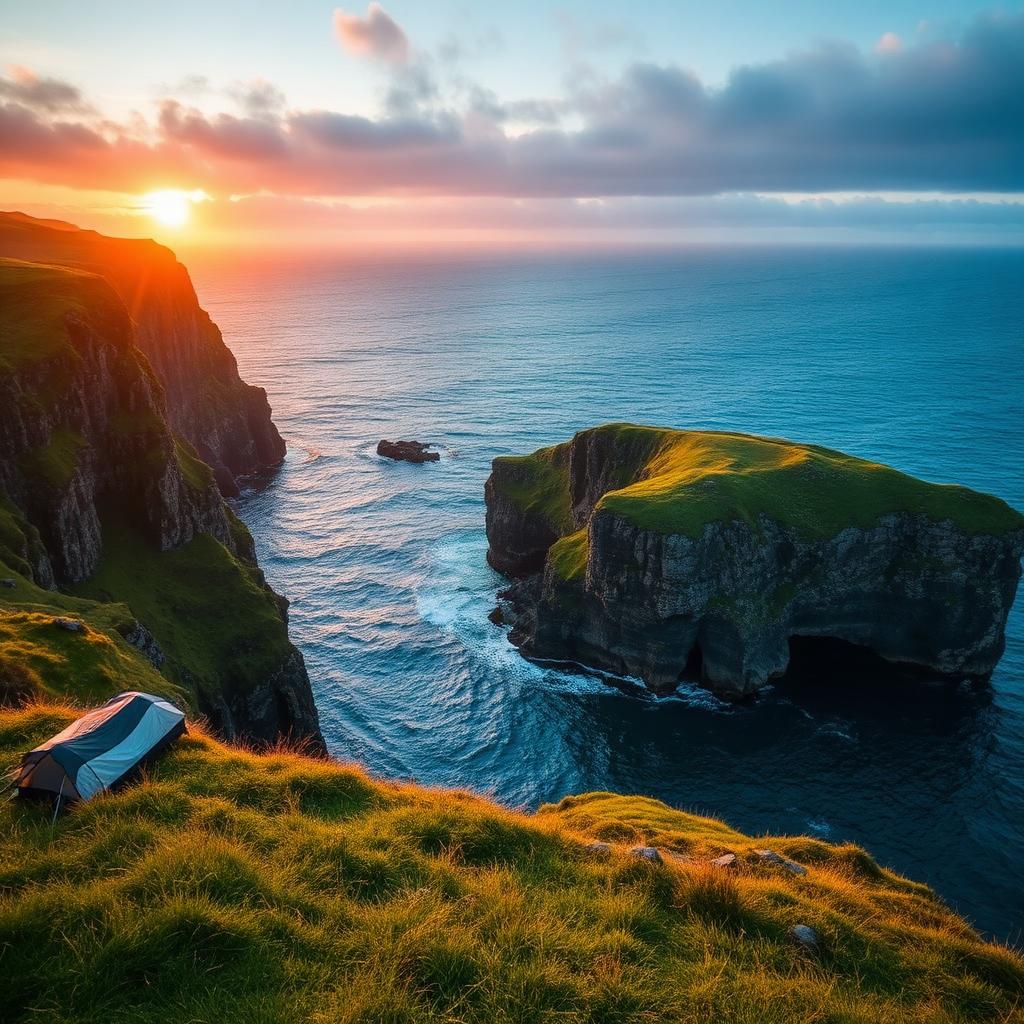
A first week on the Beara Peninsula in the southwest of Ireland, camping on the sheep-cropped grass above small headlands. Legal camping on the peninsula requires permission from landowners, which was almost universally granted with a friendly conversation at a farmhouse. The best images were made at last light, when the low sun raked across the stone walls and turned the sea metallic.
The Ring of Kerry, Ireland
A shift north to Kerry brought a week of rougher weather and dramatic light. A camp on the Skellig-facing cliffs at the western tip caught a storm rolling in from the Atlantic, and the resulting images of dark cloud above bright green cliffs above dark water were the trip's most saturated. The tent held; the sleep did not.
The Outer Hebrides, Scotland
The Outer Hebrides are a different scale of coast. A week on Harris and Lewis included white-sand beaches straight from a Caribbean brochure, framed by moor and gale. Camping is legal under Scotland's right to roam, with the responsibility to camp in small numbers, leave no trace, and avoid crops and enclosed livestock.
The image from Harris that stands out was made at midnight in June, when the light does not fully leave the sky. The camp was pitched on machair grass a hundred yards from the beach; the image showed the tent in silhouette against a sky the color of a slightly bruised peach.
Skye's northwest, Scotland
A brief trip to Skye's northwest coast caught a stretch of unusually calm weather that produced mirror-flat coastal waters and dramatic reflections of the ridge line. The tent was pitched high on a spur above a sea loch, and the morning image looking down into the loch was one of the trip's most technically satisfying.
Cornwall's north coast, England
A final week on the Cornish north coast provided a different feel. Wild camping in Cornwall is legally ambiguous but widely tolerated on the coastal path if it is discreet and low impact. The images from this stretch focused on the interplay of granite headland and Atlantic swell, and on the way the coastal light changes hour by hour.
Wind, salt and camera care
Coastal camping is hard on cameras. Salt spray works its way into every seal, and wind-borne sand is worse. Nightly cleaning with a microfiber cloth, silica-gel packets in the camera bag and a spare dry bag for the camera during storms all mattered. Two of the four bodies I carried developed problems; the two that came back healthy had lived in the dry bag whenever they were not in use.
What the coast taught
The North Atlantic coasts are one of the great camping regions of the world, and they are also difficult in ways that mountain camping is not. Wind is constant. Water is everywhere. Insects are worse than most guidebooks admit. The reward is a kind of exposed quiet that no inland landscape produces.
A month is enough time to develop small habits: pitching so the door faces away from the wind, weighting corners with rocks rather than trusting stakes in sandy soil, cooking behind the tent rather than in front of it. These are the habits of anyone who camps regularly by the sea, and they are the difference between a hard trip and a great one.